
Keeping the Main Thing the Main Thing: Music, Marching Band, and Maintaining Balance

Sometimes the most valuable advice we can give a music educator is permission to take something away.

Recently, while adjudicating a marching band competition, I participated in brief critiques with directors and instructional teams following their performances. More than once, the conversation returned to the same fundamental concern: the musical content the students were performing simply wasn't coming through.
The winds were playing. The students were clearly working. The arrangements contained interesting musical ideas. But much of that content was being covered up by percussion writing, electronic reinforcement, and sound design.
I offered what I thought was a relatively straightforward observation:
"We can only judge what we hear, and the audience can only react to what they can hear."
I encouraged the staffs to consider reducing their electronic amplification dramatically—perhaps by as much as 50 percent—and removing percussion and electronic content that competed with the wind book.
Not because the additional material was necessarily poorly written. Not because electronics or percussion were inherently problematic. But because the musical priorities had become inverted.
What struck me wasn't disagreement or defensiveness. It was relief.
Some directors seemed to recognize the problem already but needed someone outside their organization to confirm what they were hearing—or perhaps what they had been reluctant to say.
More than one staff member responded, "We're writing that down."
Sometimes the most valuable advice we can give a music educator isn't to add something.
It's permission to take something away.
Throughout my career as a music educator and educational leader, I've returned to a relatively simple philosophy: Keep the main thing the main thing.
In music education, the main thing is student achievement.
With today's increasingly sophisticated amplification, sound design, electronic reinforcement, and specialized instructional teams, I wonder whether we've sometimes lost sight of that fundamental responsibility.
Old School? Perhaps.
I'll readily admit that I'm old school.
But if old school means believing that the sounds an audience hears should fundamentally originate with the musicians performing in front of them, and that the environment in which those musicians perform should influence how we approach the music, I'm perfectly comfortable with that description.
For years, I've performed with Soul Tsunami and the Hurricane Horns, an eleven-piece funk, soul, and R&B band featuring four horns.

As the dance band industry evolved, many groups began incorporating prerecorded tracks into their performances. Sometimes those tracks filled in missing instrumental parts. Sometimes they provided additional layers of sound. And sometimes they became so integral to the performance that it was difficult to distinguish what was being played live from what was being reproduced electronically.
I've occasionally joked that this was the beginning of the Milli Vanilli version of the gigging entertainment industry.
Soul Tsunami took a different approach.
We use sound effects when appropriate. A siren in Fire. Hand claps in Car Wash. Those are musical colors that contribute to the authenticity of the original arrangements.
But the music itself?
That's eleven musicians, including four horn players, producing the sound together in real time.
We play the music essentially as it was originally performed, and we all prefer it that way.
There's something fundamentally different about hearing musicians create music together, responding to one another, balancing naturally, and shaping phrases in the moment.
It's not simply nostalgia. It's the authenticity of the musical experience.
And in music education, I believe that authenticity matters even more.
That same conviction shaped my work as Director of Fine Arts for Arlington ISD.
As we planned a major fine arts performance facility, I was determined that the primary performance hall would be a true concert hall, designed around the natural acoustic performance of instrumental and vocal ensembles.
Not a multipurpose theater that happened to accommodate concerts.
A concert hall.

Working with architects, acousticians, and other experts, a phrase emerged that has stayed with me:
"Once you go multipurpose, you go multi-nothing."
It's deliberately provocative, but the underlying concern is real.
When we compromise the acoustic environment to accommodate theatrical fly systems, extensive stage machinery, and competing performance requirements, we risk losing the qualities that allow an orchestra, wind ensemble, or choir to be heard naturally throughout the room.
Then we reach for microphones and electronic reinforcement to compensate.
We should design the environment to support the musicians rather than relying on technology to overcome decisions that work against them.
When Technology Changes the Sound
I'm certainly not writing as an outsider to electronics.
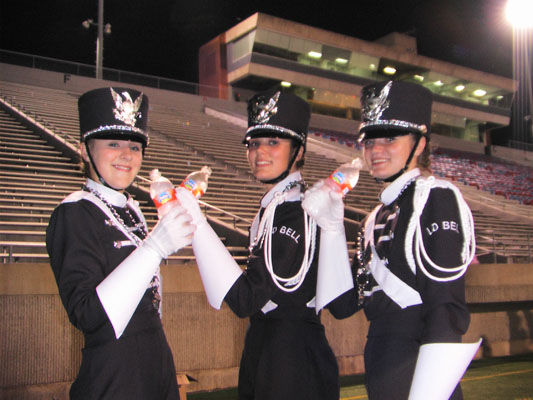
During my years at L.D. Bell, we experienced firsthand the period when amplification and sound design were becoming significant elements of competitive marching band.
I remember the transition from a director holding a Long Ranger—the wireless bullhorn—in front of a flute soloist to reinforcing that same instrument with sophisticated reverberation and effects, creating something that approached the experience of hearing it in a concert hall.
We also incorporated synthesized sounds into our productions—strings, voices, organ, and other instrumental colors our acoustic ensemble simply couldn't produce. Those sounds expanded the musical palette rather than replacing what our students were already playing.
One particularly revealing experience came during our 2006 season.
We were all in on electronics, utilizing some of the most sophisticated solo amplification available at the time, along with an electronically generated vocal effect that created an eerie, almost disturbing sigh. Like most groups early in the season, we were initially just happy everything worked!
As the season progressed, we refined the electronic elements and established what we considered an appropriate balance for Bands of America competition. We competed successfully with that balance and were quite pleased with the results.
Then came UIL—The Texas state competition system has traditionally reflected a somewhat more conservative approach to musical balance. In preparation, we revisited the relationship between our electronics and the acoustic ensemble, adjusting everything to what we considered a more appropriate UIL balance.
And something interesting happened. We listened, looked at one another, and essentially said:
“Oh...that's actually what this is supposed to sound like."
We hadn't changed the fundamental musical design. We hadn't abandoned the technology or sacrificed the creative effects that made the production distinctive.
We had simply found a better balance. And that's the balance we used for the remainder of the season.
What makes that experience particularly instructive is that we had already been successful. Our adjustments weren't made because the previous approach had failed competitively.
They were made because we were challenged to listen differently.
Sometimes we become so pleased that the technology works that we forget to ask whether we've found the right musical balance.
That experience reinforced something I've continued to believe: Technology can be thoughtfully designed, creatively effective, and entirely appropriate to the production—and still be too prominent.
The question isn't whether we should use it.
The question is whether we're allowing it to serve the music.
The Pursuit of Someone Else's Sound
The influence of Drum Corps International and the highest-achieving programs at Bands of America Grand Nationals is undeniable.
These organizations and ensembles have contributed enormously to the evolution of the marching arts. Their creativity, innovation, and performance standards have raised expectations across the activity.
But there's an important distinction that sometimes gets lost in the pursuit of competitive success.
DCI is a competitive summer performance activity that also provides significant educational experiences. Our school band programs exist first and foremost as music education programs.
Those missions certainly complement one another, but they are not identical.
At the highest levels of the marching activity, amplification has evolved to include individually miked performers, sophisticated wireless systems, sideline microphones, and increasingly complex approaches to sound reinforcement.
The resulting sound can be extraordinary.
But let's acknowledge something: It isn't necessarily the natural acoustic sound of the ensemble anymore. Some of the largest and most accomplished Bands of America ensembles have sufficient acoustic mass to incorporate these technologies while maintaining a substantial foundation of naturally produced sound. When more than a hundred brass players produce a unified musical statement, there's an acoustic presence into which amplified voices can be blended.
Even then, the result may not sound entirely acoustic. But there is a foundation.
Now consider what happens when a smaller ensemble attempts the same approach.
Sideline and shotgun microphones don't inherently know which performers should be featured. As students move across the field, individual instruments enter and leave the microphones' effective pickup areas. A particularly strong performer may suddenly become the dominant voice. Moments later, a less-developed performer may occupy that same position, and the audience hears an entirely different quality of sound. Neither necessarily reflects the intended musical balance.
The result can be a confusing listening experience in which the prominence of individual performers is determined as much by their proximity to a microphone as by orchestration, musical phrasing, or ensemble achievement.
Ironically, the technology intended to create a more consistent and powerful ensemble sound can accomplish exactly the opposite.
This is particularly concerning when smaller and medium-sized programs attempt to reproduce the production techniques of ensembles with significantly greater numbers, resources, and acoustic capabilities.
A microphone can make an instrument louder. It cannot, by itself, make an ensemble more balanced.
The question isn't simply whether the technology works.
It's whether the technology is appropriate—and for the ensemble using it.
When Louder Makes the Band Sound Smaller
One of the most common observations I share during clinics concerns something remarkably simple: the relationship between electronic amplification and the acoustic fortissimo of the ensemble.
I encourage directors and designers to establish their reference point with the actual acoustic
tutti fortissimo the ensemble can produce.
Not the sound coming through the speakers of the electronically reinforced version of the ensemble.
The natural sound of the students performing together.
That should be the foundation against which everything else is evaluated.
How often have we heard a marching band begin its production with an enormous synthesized effect, dramatic voiceover, or some other electronically generated moment, only to discover that when the full wind ensemble finally enters, it can produce perhaps 75 percent of the volume we've already heard?
Think about what we've just accomplished.
We've established an expectation of sonic power the actual ensemble cannot match. The audience experiences the first major acoustic entrance not as an arrival, but as a reduction in energy. If you arrive before an arrival, it is not an arrival.
And here's the irony: The very technology intended to make the production sound bigger has actually made the band sound smaller.
It's an entirely unforced error.
This doesn't mean every electronic effect must be quieter than the band. There are certainly artistic moments when dramatic electronic statements, intimate amplified solos, or intentionally contrasting sounds are appropriate.
But those decisions should be made with a clear understanding of the ensemble's natural acoustic capabilities and the musical relationships we're creating.
If the musical design calls for the full wind ensemble to deliver the first great moment of power, we shouldn't establish a higher perceived volume ceiling before the students ever play.
Let the ensemble establish what powerful sounds like. Then build the production around that reality.
When More Becomes Less
Another concern is the increasingly complicated relationship among wind orchestration, percussion writing, and electronic sound design.
We've all heard it.
A beautiful woodwind passage disappears beneath an amplified front ensemble. A carefully orchestrated melodic statement is obscured by battery percussion writing occupying the same rhythmic and sonic space. A harmonic arrival that should be carried by the brass is overwhelmed by synthesized reinforcement, electronic effects, or simply too many competing musical ideas.
Sometimes a woodwind line is doubled electronically to make it audible. Other times, the same musical material is reinforced by snare drums or tenor drums, creating additional rhythmic activity that effectively obscures the instruments carrying the melodic content.
The result may be impressive in terms of volume, complexity, or production value.
But what, exactly, are we hearing? And perhaps more importantly, what are we no longer able to hear?
There's a misconception that reducing percussion content, limiting electronic reinforcement, or creating more space in an arrangement somehow makes the production less sophisticated. I would argue exactly the opposite.
Great orchestration requires discipline.
It requires understanding which musical voice should be prominent, how supporting material contributes to the phrase, and when restraint can be more powerful than additional activity.
A beautifully performed woodwind line doesn't necessarily need reinforcement from a synthesizer. A brass chorale doesn't need to compete with an aggressively amplified front ensemble. And a compelling melodic statement doesn't become more compelling simply because the battery is playing something technically demanding underneath it.
Our percussion students deserve opportunities to demonstrate their own musicianship, technical excellence, and expressive abilities. Those opportunities should be thoughtfully integrated into the larger musical composition.
Every component should have a purpose. And that purpose should support the musical whole.
Sometimes the most sophisticated musical decision is knowing when not to play.
Why It Happens, and Who Must Fix It
If so many directors already recognize these issues, why do they persist?
Because the pressures are real.
Audiences respond to big moments. Programs look to the most successful ensembles for inspiration. Designers naturally want to create exciting and sophisticated productions. And directors may perceive that competitive expectations reward increasingly elaborate production values.
None of those motivations is inherently wrong. But they can lead us away from our fundamental educational priorities.
The increasingly specialized nature of our instructional and design teams adds another layer of complexity. Even relatively modest programs may employ separate individuals responsible for percussion arranging, battery instruction, front ensemble instruction, sound design, electronics, and visual design.
These individuals are often talented, enthusiastic, and deeply invested in their areas of expertise.
That's a good thing.
But it can also create situations in which individual components develop independently of the musical whole. The percussion arranger writes an exciting percussion book. The sound designer creates an impressive electronic environment. The battery staff develops demanding and technically engaging material.
And the wind players?
They're somewhere in the middle, attempting to present the melodic and harmonic substance of the composition. The issue isn't necessarily a lack of talent or good intentions. It's a lack of balance—and sometimes a lack of unified musical direction.
This is where the band director's responsibility becomes particularly important. As the educational leader of the program, the director must be more than the person coordinating schedules, managing personalities, and keeping everyone moving in the same direction.
The director must be the ultimate musical and educational decision-maker.
That means asking difficult questions.
Is this percussion writing supporting the musical phrase? Can we actually hear the woodwind contribution? Is electronic reinforcement adding something meaningful, or merely making something louder? Would this moment be more effective if we simply removed something?
And perhaps the most difficult question:
Are we willing to tell a valued member of our instructional team, "No, that isn't helping the ensemble"?
Leadership sometimes means making decisions that aren't universally popular. But our obligation isn't to keep every designer or staff member happy.
Our obligation is to the students.
Five Questions for Monday's Rehearsal
If we're serious about keeping the main thing the main thing, here are five practical questions worth considering with our instructional and design teams.
1. Have we heard the ensemble acoustically?
Run the production with the electronics off. Listen and record from the press box or an appropriate audience perspective. Understand what the students are actually producing before evaluating what the technology contributes.
2. Where is our acoustic ceiling?
Establish the ensemble's natural tutti fortissimo as the reference point for electronic amplification, soloists, and sound design. Be intentional about the relationships among those elements.
3. Is every electronic element contributing something meaningful?
Temporarily mute individual effects, reinforced passages, and electronic layers. Listen critically to what changes. Is the element enhancing the musical experience, or is it simply adding volume and complexity?
4. Who is carrying the musical phrase?
For every musical passage, identify the primary melodic or harmonic voice. Make certain the percussion writing, electronic reinforcement, and supporting orchestration allow that voice to be heard.
5. Is everyone working toward the same musical vision?
Percussion arranging, sound design, orchestration, and staging should serve a unified musical and educational purpose. That vision must be established early, communicated clearly, and continually evaluated by the director.
These aren't arguments against technology.
They're questions about musical priorities.
The Educational Question
Ultimately, as educators, we should continually return to a fundamental question:
What are we teaching, and what are our students actually learning?
If our woodwind students spend years developing tone quality, technical facility, phrasing, and musical expression, only to have their contributions electronically doubled or acoustically obscured during performance, what message are we sending?
If our brass students are asked to develop balance, blend, resonance, and harmonic awareness, but the final product is dominated by amplified sound, are we reinforcing the musical concepts we claim to value?
And if our ensembles are evaluated primarily through the lens of production rather than the clarity and quality of student performance, have we lost sight of the educational purpose of the activity?
A thoughtfully designed electronic production can absolutely coexist with outstanding acoustic musical achievement. I've experienced it, and I appreciate the tremendous creativity and expertise required to make it happen.
But the technology must remain in service to the musicians and the music.
The marching arts will continue to evolve. They should.
There will be new technologies, new approaches to design, and new opportunities for creative expression.
I welcome those developments.
But innovation without musical priorities can quickly become distraction.
And sophistication without clarity can become noise.
Our responsibility as music educators is to ensure that students remain at the center of the experience—not the electronics, not the production, not the designers, and certainly not our desire to sound like someone else's program.
Let the woodwinds be heard. Let the brass carry the musical statement. Let the percussion contribute with purpose, clarity, and musical sensitivity. Let technology enhance rather than overwhelm.
And let the audience experience the achievement of the young musicians who have spent countless hours learning to play their instruments.
Keep the main thing the main thing.
The music. The students. Their achievement.
We should use technology to reveal student achievement, not to manufacture the appearance of it.
∗ ∗ ∗
Jeremy L. Earnhart, Ed.D.
Founder & Principal
School Music & Fine Arts, LLC
Former President & CEO, Music for All
Former Director of Fine Arts, Arlington ISD & Irving ISD
Research at the intersection of educational strategy, organizational design, and school finance. Helping school leaders uncover hidden capacity, strengthen student opportunity, and improve organizational performance through strategic fine arts design.
His work has been covered by The New York Times, NPR/KERA, Marketplace, CBS 11, NBC 5, and the Fort Worth Star-Telegram. The New York Times highlighted Arlington ISD's decision to eliminate instrument rental fees, noting that band participation at the middle and high school levels "jumped" (Rich, 2015).
That work continues in The Cost of Not Playing (2026), Dr. Earnhart’s ongoing research on the systems-level impact of music participation in public schools.

His doctoral research centered around the competencies of the central office music administrator:
Earnhart, J. L. (2017). Competencies of the public school music administrator: Texas music administrator perspectives. Journal for K-12 Educational Leadership, 1(1), 55–63.


Comments