
The Hardest Job in Music Education — I Left It and Came Back

Updated: Jan 23

Jeremy Earnhart, Ed.D.
There are a lot of difficult jobs in music education.
We often measure difficulty in education by titles, credentials, and organizational position—conflating stature, visibility, and perceived stress with real load.
Central Office Fine Arts Directors manage complex systems. Some choose to pursue graduate study concurrently, adding intellectual and professional demands to an already complex role. None of that is easy—and pretending otherwise isn’t helpful.
But difficulty is not the same thing as sustained human load.
And when we’re honest about total load—not prestige, not credentials, not perceived authority—the combined difficulty of central office administration plus doctoral pursuit still does not outweigh the demands of high school head band directing.
When we talk honestly about where the most relentless, high-stakes, no-buffer work in music education lives, the answer is not central office—and it’s not a set of letters after your name.
I write this as someone who’s been on both sides of this equation—and as someone who is currently back on the podium, with kiddos under the Friday night lights.
We Need a Better Definition of “Hard”
In education, we often define “hard” by credentials, titles, or proximity to policy. That definition misses where the real pressure lives.
A harder—and more honest—definition looks like this:
Hard is daily exposure to hundreds of students.
Hard is constant emotional labor.
Hard is making decisions that have consequences immediately.
Hard is performing publicly, repeatedly, with no rewind button.
Hard is knowing that a bad week doesn’t just affect you—it affects kids, families, and a community.
And it’s not just the weight of those decisions—it’s the velocity. The speed at which they arrive, stack, and demand response.
By that definition, the hardest jobs in music education are the ones where decisions meet students first.
Frontline Teaching Is Where the Weight Lives
If you’ve directed a large secondary ensemble—band, choir, orchestra—you already know this reality. While my own experience is rooted most deeply in band, the structural load I’m describing applies to any large, performance-facing secondary ensemble.
The work happens in real time. Students show up whether you’re ready or not. Parents have expectations. Administrators want results. Budgets don’t flex. Calendars don’t slow down.
Performances happen whether the week went well or not.
There is no insulation layer between your decisions and their consequences.
And importantly, this isn’t just a secondary issue.
Elementary music teachers understand this load deeply. Teaching every child in a building means no hiding days, no small rosters, no quiet periods—just a constant stream of developing humans, all year long—the youngest of whom have been alive just 60 months.
The work is different in shape.
The weight is not.
What Central Office Work Actually Is
Central office fine arts leadership matters. Systems matter. Policy matters. Advocacy matters.
But systems work is not the same as frontline work—and even when paired with doctoral pursuit, it does not exceed the sustained load of high school head band directing.
Central office roles typically include scheduled meetings, predictable rhythms, staff buffers, authority without daily performance consequences, and decisions that unfold over months—not by 7:00 p.m. tonight.
When a board meeting runs long, you reschedule dinner.
When a halftime show falls apart, 200 students walk off the field knowing it—and so do the parents in the stands and the administrators watching from the press box. That moment doesn’t stay at work. You carry it home.
Doctoral study adds intellectual rigor, writing pressure, and long-term deadlines. But it is largely self-regulated, internally paced, and buffered by institutional flexibility.
A bad dissertation week is recoverable.
A bad week in October often isn’t.
Taken together, central office administration plus doctoral pursuit still allow for insulation—from daily student volatility, from public performance consequences, and from nonstop emotional labor.
Central office work is about managing systems.
Doctoral work is about mastering knowledge.
High school head band directing is about carrying both—simultaneously—inside a living system that never pauses.
Why the Combined Comparison Still Falls Short
Earning a doctorate is intellectually demanding. Central office leadership is organizationally complex.
But even combined, these pursuits do not replicate the conditions of high school head band directing.
Doctoral work allows for negotiation.
Central office work allows for delegation.
Both allow for delayed consequence.
High school head band directing allows for none of that.
Failure doesn’t pause. It compounds. And it lands immediately—on students, families, performances, and program trust.
The hardest work in music education isn’t additive on a résumé. It’s multiplicative in real time.
The Lived Comparison
This conclusion isn’t theoretical for me.
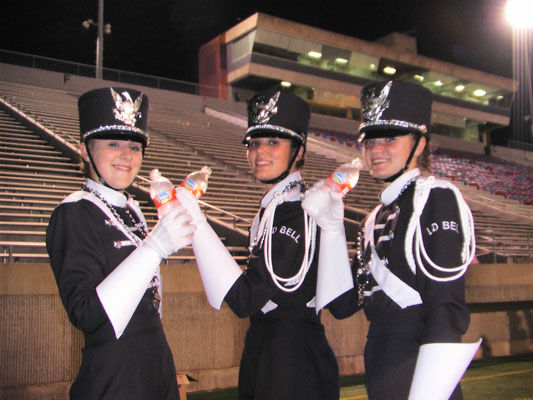
I’ve spent thirteen years as a band director — eleven at L.D. Bell High School — and sixteen years in administrative roles across Irving ISD, Arlington ISD, and Music for All. I completed my doctorate during my Irving and Arlington tenure, finishing my dissertation second in my cohort (by about a week — Shannon, you got lucky 🙂) while working full-time in district leadership.
I’ve lived the full arc.
I’m back in a high school band hall—and the article I knew needed to be written a decade ago now feels unavoidable.
Central Office + Graduate Work < High School Band Directing
Not because of intelligence.
Not because of work ethic.
But because there is no insulation, no pause, and no separation between decision-making and consequence.
Every day carries students, families, performances, and public trust—simultaneously. And the long-term decisions involved are the kind where being just a few degrees off can send you into Back to the Future Part II territory.
I didn’t leave the classroom because I couldn’t do the work. I left because I had done it—and understood its cost.
And because our daughter had just been born. Life required a different choice for a season.
But I came back.
The Quiet Truth We Don’t Say Out Loud
Here’s the uncomfortable reality inside music education:
Many of the best teachers leave the classroom not because they weren’t good at the work—but because they were.
We quietly frame distance from students as “advancement.” We treat titles and credentials as evidence of increased difficulty.
In music education teacher preparation, authority too often rests with higher-education faculty whose distance from public school classrooms insulates them from consequences—and from the need to question whether their conclusions are wrong. Higher education has normalized a troubling exchange: writing about teachers and the systems in which they practice increasingly substitutes for having been one beyond the brief, credentialing window required of DMA and PhD programs.
Our systems reward distance not because it’s harder—but because it’s survivable.
That doesn’t make anyone dishonest. But it does mean we’ve confused upward movement with increased load.
Why This Matters
When we fail to name where the hardest work actually lives, we design systems that burn out the people closest to students. We lose exceptional educators. We normalize attrition—and then act surprised when access, stability, and participation suffer.
If we want healthier programs and sustainable careers in music education, we have to stop pretending that proximity to students is the easy part.
It isn’t.
The hardest jobs in music education are not the ones furthest from kids.
They’re the ones that never get a day away from them.
I know—because I left.
And I came back.
Jeremy Earnhart, Ed.D. is the author of The Cost of Not Playing — A widely circulated white paper (2026) examining how music participation shapes the financial health of school districts (43K + reads).
His Doctoral research centered around the Competencies of the Central Office Music Administrator:
Earnhart, J. L. (2017). Competencies of the public school music administrator: Texas music administrator perspectives. Journal for K-12 Educational Leadership, 1(1), 55–63. Dallas Baptist University.


Comments