
What Today's Graduate Is Actually Walking Into
- Jeremy Earnhart

- Jun 2
- 4 min read
Updated: Aug 9
Part I of III — Casio PT-1, AI, and All of Us
Part II: The Swiss Army Knife Graduate
Jeremy Earnhart, Ed.D.

Imagine a set of Tinker Toys floating in the International Space Station.
Now put them in a blender.
Bulldoze them.
Run them over with a steamroller.
Shatter them into a million pieces and scatter them across every data farm being built on this planet right now.
That is what today's graduate is going to be asked to interpret, synthesize, improve — and out of which build a better mousetrap.
And if they can't do that?
There may not be a job for them.
This is not a warning about artificial intelligence replacing workers. That framing is already outdated. The real question is not whether machines will do more. They will. The question is what kind of human being can still stand in the room and matter — not because they performed a task, but because they could see what the task was asking, and why it mattered, and what it was missing.
That requires something no algorithm has yet replicated.
It requires a person who was trained — genuinely trained — to hold complexity, work inside ambiguity, collaborate under pressure, lead with creativity, and communicate meaning in real time.
Schools have spent three decades arguing about whether that kind of education is practical.
AI just answered the question.
I know this student.
I was this student.
***
My PSAT score was... unremarkable. I was told taking Latin would have helped — nope. But the standardized testing system had no way of measuring the cognitive chaos I was learning to navigate every day in the music room. My guidance counselor — well-meaning, Long Island accent intact — looked at my numbers and offered what he believed was reassurance: Jeremy, this is fine. You're going into music. You don't need the prep classes. It's all going to be great.
He wasn't wrong about the score. He was wrong about what it meant.
What the score didn't measure was what I was actually building — every rehearsal, every performance, every moment of leading a large ensemble through complexity and pressure and the requirement to produce excellence in real time in front of thousands of people.
The system had one column. I was filling ten others.
A few months later, the same counselor called me back down to his office. He had a large reference book and genuine concern. I had been offered a full scholarship to the University of Arkansas. He leaned across the desk: Jeremy, we need to talk about Arkansas. Their biggest major is poultry farming. What if this music thing doesn't work out? You need to go to North Texas.
He wasn't wrong about North Texas.
I visited Michigan. Indiana. We walked away from both — the people we met told us everything we needed to know. Miami was fine. Tennessee offered me a scholarship. Every school sent materials. Some of it arrived on stationery flowery enough to smell.
One professor showed up and taught a lesson. Then called back months later to follow up.
That was Dr. Leonard Candelaria at the University of North Texas.
We took the $200 scholarship — it waived the out-of-state tuition — and never looked back.
I sent my SAT scores to Harvard, Yale, and the University of North Texas College of Music — one of the premier music programs in the world.
I knew where I was going.
Our daughter plans to be there too.
***
Somewhere in the music department of every high school in America is a kid who doesn't know they're in the top twenty-five of their graduating class until someone calls them to take the picture.
That was me.
I sat there next to my comrade Chris Kerzsko — number twenty-four, second trumpet in the band — and we looked at the other twenty-three people around us and quietly did the math. If those bleachers had collapsed and things had gone a different way, we could have been valedictorian and salutatorian.
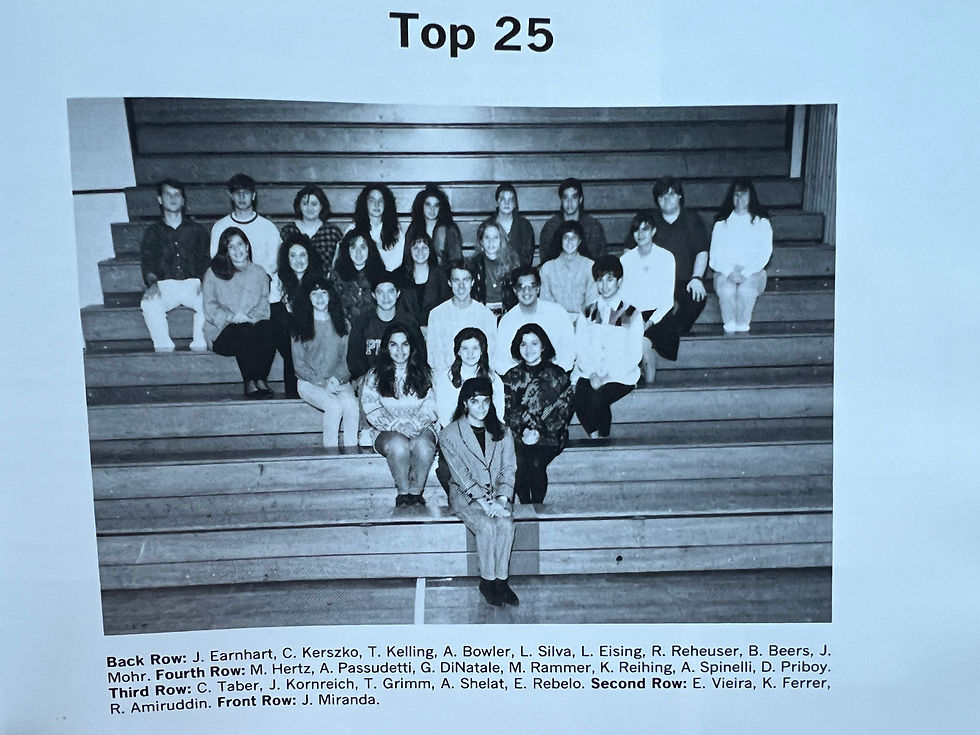
The ranking system had no column for what we were building in that band room. But we were building it every single day.
Those are not soft skills.
Those are the only skills that matter when the Tinker Toys have been blended, bulldozed, steamrolled, and scattered across a million data farms.
The question is not whether artificial intelligence is coming.
The question is whether your school is tracking the wrong metrics, or building the human capacity to survive the chaos.
Because the graduate who will stand in that room and matter — who will interpret the chaos, synthesize the noise, and build the better mousetrap — isn't necessarily the one the ranking system saw.
It might be the one nobody (yet) called to take the picture on the bleachers.

***
Jeremy L. Earnhart, Ed.D.
Founder & Principal
School Music & Fine Arts, LLC
Former President & CEO, Music for All
Former Director of Fine Arts, Arlington ISD & Irving ISD
Research at the intersection of educational strategy, organizational design, and school finance. Helping school leaders uncover hidden capacity, strengthen student opportunity, and improve organizational performance through strategic fine arts design.
His work has been covered by The New York Times, NPR/KERA, Marketplace, CBS 11, NBC 5, and the Fort Worth Star-Telegram. The New York Times highlighted Arlington ISD's decision to eliminate instrument rental fees, noting that band participation at the middle and high school levels "jumped" (Rich, 2015).
That work continues in The Cost of Not Playing (2026), Dr. Earnhart’s ongoing research on the systems-level impact of music participation in public schools.

His doctoral research centered around the competencies of the central office music administrator:

Comments