
The Accidental Masterpiece: Why North Texas Built America's Most Comprehensive Public Schools

Updated: Aug 9

When educators visit North Texas for the first time, they often ask the wrong question.
They ask why the bands are so large.
Why football stadiums resemble college venues.
Why orchestras, CTE programs, debate teams, robotics clubs, and fine arts departments seem unusually comprehensive.
The better question is:
How did this happen?
The answer is not football.
It is not band.
Those are outcomes.
The answer is organizational design.
Educational opportunity is not merely a function of funding or curriculum. It is also a function of organizational design.
North Texas became what it is through the convergence of history, geography, economics, public policy, and a remarkable amount of fortunate timing.
Air Conditioning Changed Everything
Modern North Texas would be difficult to imagine without air conditioning.
Before climate control, the region could grow, but it could not easily sustain the explosive suburban development that followed World War II. Homes, office parks, shopping centers, and eventually major corporate campuses became practical.
Population followed.
Air conditioning is often credited with fueling the rise of the Sunbelt.
Economists have suggested a more nuanced explanation: climate control was an enabling condition rather than the sole cause. Highways, aviation, economic opportunity, and corporate investment mattered as well.
That distinction matters.
Comfort made growth possible.
It did not, by itself, make growth comprehensive.
The Districts Were Already There
Long before North Texas became one of America's fastest-growing regions, much of the organizational framework for its public schools already existed.
The Gilmer-Aikin reforms of 1949 fundamentally reshaped Texas public education by modernizing governance, finance, and district organization. At the same time much of the country continued operating through thousands of relatively small municipal school districts, Texas generally evolved toward geographically larger school districts capable of serving growing communities.
When North Texas began its extraordinary population expansion, districts did not need to be recreated.
They simply grew.
In other words:
What began as a financial model became an educational model.
Unlike many parts of the Northeast and Midwest, where public education evolved around relatively small municipal school districts, North Texas generally did not continue subdividing growing communities into increasingly smaller educational systems. As the region expanded, existing districts typically grew with their populations rather than being repeatedly fragmented into new districts.
The result was what might be described as a "big box" public school model—not in architecture, but in organizational design. Rather than distributing students across dozens of small systems, large, geographically expansive districts leveraged organizational scale to provide a breadth of educational opportunities that smaller systems often struggle to sustain. Finance almost certainly influenced that evolution. What began as an efficient governance model ultimately became a lasting educational advantage.
Scale Creates Opportunity
Large enrollment does far more than increase headcount. It creates organizational efficiency.
More importantly, it creates participation density.
Students are not simply spread across more schools and more programs. They are concentrated in ways that make comprehensive opportunities more financially sustainable.
This is where educators experience economies of scale—not as accounting formulas, but as opportunities.
Another AP course.
Another concert band.
Another orchestra.
Another dual-credit opportunity.
Another engineering pathway.
Another welding lab.
Another robotics team.
Another theater production.
Students simply experience more because enough students exist to support more.
Large districts are not without challenges. Size can create bureaucracy, transportation demands, and governance complexity. Yet North Texas demonstrates that, when managed well, organizational scale becomes an educational asset rather than merely an administrative characteristic.
North Texas did not simply become larger.
It became larger inside organizations already designed to leverage scale.
That may be the most overlooked educational advantage in America.
Then Came DFW
When DFW International Airport opened in 1974, North Texas entered an entirely different chapter. Corporate headquarters followed. Employment followed. Families followed.
School enrollment expanded with the population.
When the airport opened, the Dallas–Fort Worth metropolitan area was home to roughly 2.97 million residents, according to the 1970 U.S. Census—the closest available benchmark to the airport's opening. Today, more than 8.3 million people call the region home, an increase of more than 5 million residents during one of the most remarkable periods of metropolitan growth in American history. No single institution created that transformation.
Yet DFW Airport, American Airlines, and the businesses they attracted became defining pieces of the infrastructure that connected North Texas to the national and global economy. The Federal Reserve Bank of Dallas reports that the region remains among the nation's fastest-growing metropolitan areas, adding more than 150,000 residents in 2023.
The airport did not create great schools.
It accelerated the growth of communities whose educational infrastructure was already capable of absorbing that growth.
School districts expanded with population.
Educational opportunity expanded with them.
Scale Shapes Leadership
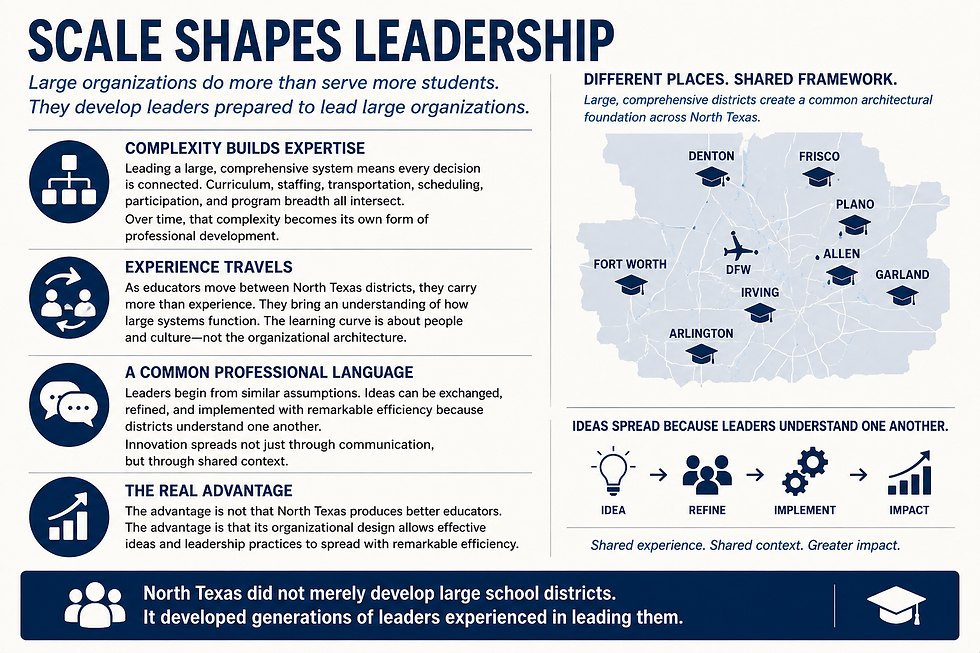
Organizational scale creates another advantage that is rarely discussed. It shapes the way educational leaders think.
Leading a large, comprehensive school system requires a different set of organizational experiences than leading a much smaller one. Questions of curriculum design, master scheduling, staffing, transportation, participation density, and program breadth become interconnected. Decisions are seldom made in isolation because nearly every decision affects something else.
Over time, that complexity becomes its own form of professional development.
As educators move between North Texas districts, they carry with them not only experience, but also a shared understanding of how large educational systems function. The learning curve often centers on people and community culture rather than organizational structure because the underlying architecture is already familiar.
Perhaps most importantly, that shared experience creates a common professional language. Ideas can be exchanged, refined, and implemented with remarkable efficiency because leaders often begin from similar organizational assumptions. Innovation spreads not simply because districts communicate with one another, but because they understand one another.
The advantage is not that North Texas produces better educators. The advantage is that its organizational design allows effective ideas and leadership practices to spread with remarkable efficiency.
North Texas did not merely develop large school districts.
It developed generations of leaders experienced in leading them.
Communities Built Identity
Some communities took the model even further.
Allen.
Duncanville.
Southlake Carroll.
Different communities.
Different demographics.
The same phenomenon.
Scale created opportunity.
Community identity amplified it.

These communities did not merely support their schools. They chose to preserve a single comprehensive high school as the center of community life.
For perspective, the enrollment cutoff for Texas UIL Class 6A in 2026–2027 is 2,215 students. Allen High School enrolls more than 5,200 students. Duncanville High School serves approximately 4,400. Southlake Carroll's split-campus model approaches 5,500 students across Grades 9–12. Despite their different demographics and histories, each community concentrated its educational identity around a single flagship high school.
They built part of their civic identity around them. The mascot became part of the city's identity. Friday night football became a community gathering.
Marching bands became civic ambassadors.
Academic excellence became a point of local pride.
The school was no longer simply located within the community. It became part of the community's identity. For many residents, the two became inseparable.
An Accidental Masterpiece
No single person designed this system. No commission could have predicted its outcome. There was no Robert Moses for North Texas public education—no single architect drawing a comprehensive blueprint. Instead, generations of legislators, educators, elected officials, developers, and community leaders made decisions that solved immediate challenges. Only in retrospect do those decisions reveal a larger design.
Some decisions were intentional. Others were reactions to changing circumstances. Still others were simply fortunate timing. History rarely unfolds according to one master plan. Remarkable systems emerge from hundreds of interconnected decisions made over decades.
North Texas may be one of the finest examples.
Today's students inherit one of the most comprehensive public education ecosystems in America—not because someone intentionally designed extraordinary band programs or Friday night football traditions, but because generations of leaders built institutions capable of converting population into opportunity.
That distinction matters.
Football is an outcome.
Band is an outcome.
Comprehensive educational opportunities are outcomes.
Organizational scale made those outcomes possible.
The Legacy Nobody Designed
Perhaps the greatest educational innovation in North Texas was never an innovation at all. It was preserving enough organizational scale to make extraordinary educational opportunity possible.
Sometimes the greatest educational advantage is not found in adding another program.
Sometimes it is found in preserving the organizational design that makes every program possible.
North Texas did not accidentally build great bands.
It accidentally built a system capable of building great schools. Great bands, outstanding career pathways, strong academics, championship athletics, and comprehensive student opportunities were the natural outcomes of that design.
That may be North Texas' greatest educational legacy—and its most accidental masterpiece.
∗ ∗ ∗
Jeremy L. Earnhart, Ed.D.
Founder & Principal
School Music & Fine Arts, LLC
Former President & CEO, Music for All
Former Director of Fine Arts, Arlington ISD & Irving ISD
Research at the intersection of educational strategy, organizational design, and school finance. Helping school leaders uncover hidden capacity, strengthen student opportunity, and improve organizational performance through strategic fine arts design.
His work has been covered by The New York Times, NPR/KERA, Marketplace, CBS 11, NBC 5, and the Fort Worth Star-Telegram. The New York Times highlighted Arlington ISD's decision to eliminate instrument rental fees, noting that band participation at the middle and high school levels "jumped" (Rich, 2015).
That work continues in The Cost of Not Playing (2026), Dr. Earnhart’s ongoing research on the systems-level impact of music participation in public schools.

His doctoral research centered around the competencies of the central office music administrator:



Comments