
The Unexpected Attendance Strategy: What Virginia's Arts Education Research May Be Telling Us

Updated: Aug 9
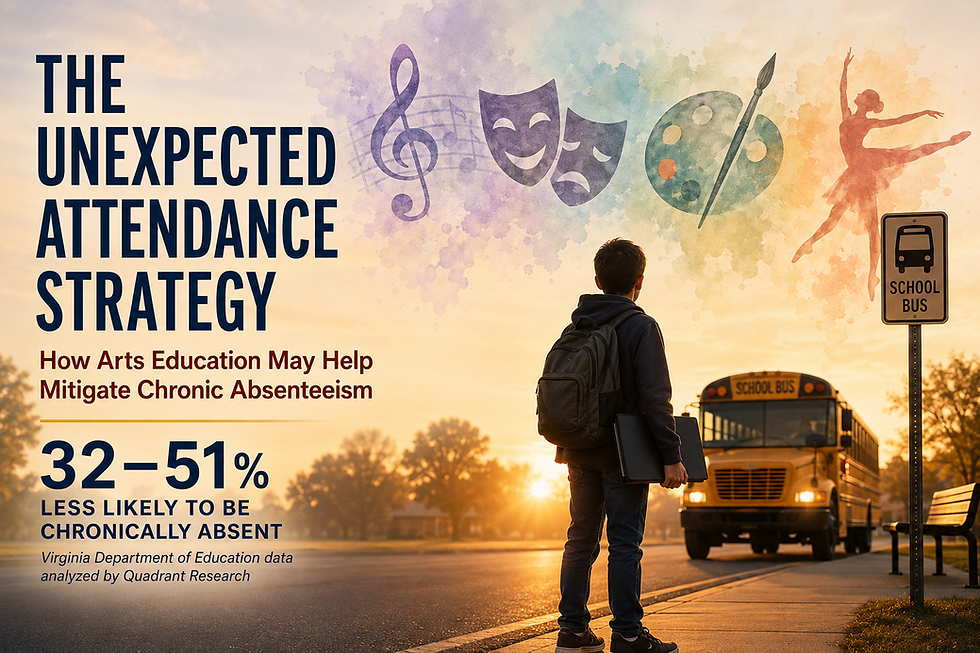
Students completing sustained arts coursework were 32.3% to 50.8% less likely to be chronically absent than their peers.
Leadership Insight
In March 2024, the Virginia Department of Education presented one of the most significant arts education findings of the past decade to the Virginia Board of Education.
Students completing four years of fine arts coursework were 32% to 50% less likely to be chronically absent than their peers.
Attendance isn't valuable simply because students are physically present. Attendance is valuable because the habits required to keep showing up are themselves among education's most important outcomes.
In states that fund schools by daily attendance, that arithmetic is direct: absence isn't just lost learning — it's lost revenue. Virginia's model works differently, and that distinction matters. More on that below.
Virginia Department of Education Meeting
Fine Arts & Chronic Absenteeism Report
March 28, 2024
Using multiple years of student-level data from the Virginia Department of Education, Quadrant Research examined outcomes for students who completed four years of arts education during high school. These findings were significant enough to be presented to the Virginia Board of Education and subsequently highlighted by the Virginia Department of Education through its #AttendanceMattersVA campaign.
"Seniors enrolled in four years of fine arts courses each year since 2020 demonstrate a
32% to 50% lower absenteeism rate than those who did not take a fine arts course
during high school. These findings hold when comparing data across fine arts disciplines and for key variables such as race/ethnicity, enrollment in Free and Reduced-Price Meal programs, and English Learners"
Source: Virginia Department of Education Facebook, #AttendanceMattersVA Campaign — March 28, 2024
Outside Virginia—and outside the arts education community—the finding received surprisingly little national attention.
It should have.
The study does not establish causation. Like most educational research, it identifies a meaningful relationship rather than proving one variable caused the other.
Nevertheless, the finding aligns with something educators have understood for generations:
Students are more likely to attend places where they feel connected.
Every day a student misses school is a day of instruction that can never be recovered.
Schools can reteach a lesson. Teachers can provide tutorials. Counselors can offer additional support.
But no school can recreate yesterday's classroom.
That simple reality has made chronic absenteeism one of the defining educational challenges facing American education. Across the country, states and school districts are investing significant time, funding, and personnel into improving student attendance because they understand a fundamental truth:
Students cannot benefit from learning opportunities if they are not present to receive them.
What helps students keep showing up?
One answer may have been hiding in plain sight.
Belonging Is an Attendance Strategy
Students are more likely to attend places where they feel connected.
Arts programs create those conditions by design. Whether through band, orchestra, choir, theatre, dance, or visual arts, students become part of a community in which their presence matters and their absence is noticed.
That sense of belonging may be one of the most overlooked attendance strategies available to schools.
Educational Systems Are Multiplication Machines
Educational leadership is fundamentally different from classroom instruction because educational systems multiply everything.
In The Cost of Not Playing, I explored how relatively small differences in music participation could create significant staffing and financial implications when expanded across thousands of schools. Attendance follows the same mathematics.
Five students become five hundred.
One percentage point becomes thousands of students.
One additional day becomes millions of instructional hours.
One additional attendance day may seem insignificant. One percentage point may appear modest.
However, small improvements, consistently applied across large educational systems, become transformational.
The Attendance Dividend
The illustration below is intended to demonstrate scale rather than predict a precise outcome. Using the chronic absenteeism differences reported in Virginia together with the Commonwealth's published attendance improvements, it estimates the instructional time potentially associated with sustained arts participation.

Now imagine 100 high school students.
Applying Virginia's findings suggests a cohort of 100 students could generate approximately 200 to 300 additional attendance days each year under similar attendance patterns.
Those are more than numbers on an attendance report.
They represent:
More students in classrooms.
More instructional time.
More opportunities to learn.
More students on a path toward graduation.
A seemingly modest reduction in chronic absenteeism becomes millions of additional instructional hours when multiplied across an entire educational system.
Attendance creates opportunity.
Opportunity creates possibility.
Attendance is one of the few educational outcomes that compounds.
Every additional day in school increases the opportunity for every other educational investment to matter.
Schools Measure Knowledge — Life Rewards Character
Knowledge may help students pass the test.
Habits determine whether they pass through life.
Our accountability systems understandably focus on what students know. We measure reading proficiency, algebra readiness, science achievement, graduation rates, and college readiness. Those things matter.
But employers, universities, military leaders, and communities often ask a different question:
Who has this student become?
Can they be counted on?
Can they work with others?
Do they finish what they start?
Can they persevere when things become difficult?
Will they show up when they're needed?
One of the most influential discoveries in education and economics over the past two decades is that cognitive ability alone does not fully explain long-term success.
Economist James Heckman famously illustrated this distinction through what has become known as the "GED paradox." Individuals earning a GED generally demonstrate academic knowledge comparable to traditional high school graduates, yet their long-term outcomes more closely resemble those of high school dropouts. The difference, Heckman argued, wasn't intelligence. It was the collection of noncognitive skills—persistence, reliability, conscientiousness, and self-discipline—that traditional graduates developed and demonstrated by completing four years of school.
This helps explain why Virginia's attendance data deserves our attention. Music programs don't simply teach scales, rhythms, and concert literature. They cultivate habits of preparation, reliability, perseverance, and accountability. In other words, they don't just develop knowledgeable students—they develop dependable ones.
Perhaps that is why attendance deserves to be viewed differently. Attendance is not simply a measure of whether students came to school today. It may also be an early indicator of the habits that predict success tomorrow. Every rehearsal attended, every section rehearsal completed, every concert prepared for, and every commitment honored becomes another opportunity to practice the very qualities that research suggests matter most long after graduation.
Improving the Return on Public Investment
Every instructional day requires teachers, transportation, facilities, counselors, instructional materials, technology, food service, and countless other resources.
Those investments occur whether every student attends or not.
When students are absent, schools generally do not spend dramatically less money that day. Instead, communities receive less educational return from an investment that has already been made.
Improving attendance increases the return on that investment.
Virginia funds school divisions through Average Daily Membership (ADM), which counts enrolled students whether present or absent. That's why the case here is about return, not revenue — the money is already spent regardless of attendance. Many other states fund districts through Average Daily Attendance (ADA) instead, where per-pupil dollars are tied directly to daily presence. In those states, the connection between arts participation and attendance isn't just good policy. It's payroll.
That perspective changes the conversation.
Attendance is not simply an accountability metric.
Attendance is an educational efficiency strategy.
Looking Beyond Attendance
Attendance is not the destination.
It is the beginning.
Students who attend consistently are more likely to earn credits. Students who earn credits are more likely to graduate. Graduates are more likely to pursue higher education, technical training, military service, or stable employment.
Communities benefit from a more educated workforce, stronger civic participation, greater lifetime earnings, and increased economic opportunity.
No single educational program can claim responsibility for those outcomes. Nor should it.
But if sustained participation in music and the arts helps more students come to school consistently, it strengthens one of the earliest measurable links in that entire chain. Their impact extends well beyond the rehearsal hall—to classrooms, graduation stages, workforces, and communities.
And perhaps, over time, they help expand educational and economic opportunity while contributing to efforts to reduce intergenerational poverty.
That possibility deserves further study.
Perhaps We've Been Looking for the Wrong Outcomes

For decades, conversations about arts education have focused on creativity, academic achievement, and social-emotional learning. Those outcomes remain important.
But perhaps another question deserves equal attention.
Can sustained participation in music and the arts help schools mitigate chronic absenteeism?
Virginia's research suggests the answer may be yes.
If future research continues to support these findings, arts education should be viewed not simply as an enrichment opportunity, but as one component of a comprehensive strategy for strengthening school connectedness, improving attendance, and expanding opportunities for student success. But perhaps Virginia's most important contribution extends beyond attendance.
The data were never the problem.
We have more educational data than at any point in history. The challenge is no longer collecting more information. The challenge is asking better questions of the information we already possess.
Virginia's attendance findings may represent not the conclusion of a research project, but the beginning of a broader research agenda.
If attendance can be studied this way, what other educational outcomes are already waiting to be discovered within state longitudinal data?
Perhaps that is Virginia's greatest contribution.
Attendance is not simply about filling seats in classrooms. It is about shaping the habits that fill lives with opportunity. If Virginia's findings continue to hold, perhaps the greatest contribution of music education is not merely helping students come to school—it is helping them become the kind of people who keep showing up long after graduation.
References
Primary Sources
Virginia Board of Education. Presentation on the Virginia Arts Education Data Project (March 2024). https://www.doe.virginia.gov/home/showpublisheddocument/53389/638466146537200000
Virginia Board of Education. Agenda Memorandum – Virginia Arts Education Data Project.
https://www.doe.virginia.gov/home/showpublisheddocument/53387/638466146529870000
Virginia Department of Education. #AttendanceMattersVA: Chronic Absenteeism and the Arts in Virginia Public Schools. https://www.facebook.com/VDOENews/posts/pfbid029y6KrALk4Cjc96GFGmx61dwQzBrUW8hPxUxjW4Pyq6bfkA4NuzmpoR17rAH9mFSBl
Virginia Department of Education. Attendance Matters statewide attendance reports.
https://www.doe.virginia.gov/teaching-learning-assessment/all-in-va/attendance-matters
Supporting Research
Morrison, R. B., Bollino, A., Bisogno, K., & McCormick, P. (2024). Chronic Absenteeism and the Arts in Virginia Public Schools: A Statistical Review.
https://drive.google.com/file/d/1NrkL7Lgfu1rXpJ1UM6xMfVWcseyIGnC5/view
Arts Education Partnership Data Working Group. (2024). Arts Education Data and Reporting Initiatives 2024. https://www.aep-arts.org/wp-content/uploads/Arts-Education-Data-and-Reporting-Initiatives-2024.pdf
Virginia Department of Education – #AttendanceMattersVA. https://www.doe.virginia.gov/state-board-data-funding/accreditation-accountability/school-performance-and-support-framework/supporting-virginia-learners/educator-supports/chronic-absenteeism
Virginia Attendance Matters Dashboard. https://www.doe.virginia.gov/state-board-data-funding/data-reports/statistics-reports/interactive-data-dashboards
Related Reading
Gormly, K. B. (2026, February 16). Fighting Absenteeism with the Arts. Yamaha Music. https://hub.yamaha.com/music-educators/prog-health/advocacy/fighting-absenteeism-with-the-arts/
∗ ∗ ∗
Jeremy L. Earnhart, Ed.D.
Founder & Principal
School Music & Fine Arts, LLC
Former President & CEO, Music for All
Former Director of Fine Arts, Arlington ISD & Irving ISD
Research at the intersection of educational strategy, organizational design, and school finance. Helping school leaders uncover hidden capacity, strengthen student opportunity, and improve organizational performance through strategic fine arts design.
His work has been covered by The New York Times, NPR/KERA, Marketplace, CBS 11, NBC 5, and the Fort Worth Star-Telegram. The New York Times highlighted Arlington ISD's decision to eliminate instrument rental fees, noting that band participation at the middle and high school levels "jumped" (Rich, 2015).
That work continues in The Cost of Not Playing (2026), Dr. Earnhart’s ongoing research on the systems-level impact of music participation in public schools.

His doctoral research centered around the competencies of the central office music administrator:



Comments