
The Hidden Cost of Class Rank: When Schools Accidentally Push Students Out of the Arts

Updated: Aug 9
"Every educational system produces exactly the outcomes it is designed to produce."
This article is part of School Music Consulting's Leadership & Policy series exploring how educational systems shape student opportunity.

Over the past several months, I've written about the financial impact of comprehensive music programs (The Cost of Not Playing), the relationship between sustained arts participation and student attendance (The Unexpected Attendance Strategy), the unintended consequences of master scheduling (IB Means, In Band), and why comprehensive public schools remain one of America's greatest educational inventions (The Accidental Masterpiece).
∗ ∗ ∗
There is central a question I increasingly find myself asking as I've work with school systems across the country.
Do our policies encourage the educational experiences we say we value?
It sounds like a simple question.
In reality, it is one of the most important questions educational leaders can ask. Students don't wake up one morning and decide to abandon band, choir, orchestra, theatre, dance, or visual art.
They respond to incentives.
When a school system rewards one set of choices while unintentionally penalizing another, even highly motivated students begin making different decisions. Not because they've lost interest. Not because they've stopped believing in the value of the arts. Simply because the system has quietly communicated that one path matters more than another.
Several years ago, Arlington ISD confronted exactly that challenge.
The solution wasn't to make the arts more important.
The solution was to ensure the district's policies reflected the educational values it already embraced.
Every Policy Sends a Message
Schools communicate their priorities in many ways.
Mission statements.
Graduate profiles.
Strategic plans.
But students often learn what a school truly values somewhere else.
Schedules.
Graduation requirements.
Weighted GPA.
Class rank.
Those policies quietly shape thousands of student decisions every year.
If Advanced Placement, International Baccalaureate, and Dual Credit coursework receive weighted GPA while advanced artistic study does not, students receive a message—even if no adult ever says it aloud.
"Some courses count more than others."
For students competing for class rank, automatic university admission, or highly competitive scholarships, that message has real consequences. Many continue participating in music and the arts despite the disadvantage. Others begin asking a question they should never have to ask.
"Can I afford to stay?"
A False Choice
This was never intended to become a choice between academic rigor and artistic excellence.
In reality, it rarely is. The students enrolled in advanced music, theatre, dance, and visual arts courses are often the very same students taking Advanced Placement, International Baccalaureate, Dual Credit, and other rigorous academic coursework.
They are exactly the kinds of students schools hope to develop.
Yet when policy unintentionally creates a penalty for remaining in advanced Fine Arts coursework, students begin making scheduling decisions based on incentives rather than educational value.
No one intended that outcome. But educational systems are multiplication machines. Small policy decisions become thousands of student decisions. Thousands of student decisions become districtwide outcomes.
The Audit Illusion
Some school districts attempt to solve this problem by allowing students to audit Fine Arts courses. In other words, the students participate in the program, but do not recieve a grade.
At first glance, the policy seems reasonable. Students can remain in band, choir, orchestra, theatre, dance, or visual art without lowering their GPA.
You'll often hear it explained this way:
"Auditing Fine Arts doesn't hurt your GPA."
Technically, that's true.
But it isn't the whole story.
It also doesn't help... so it does.
When a Fine Arts course is audited, it is excluded from GPA calculations. The student's GPA isn't reduced by participating in the arts.
Meanwhile, classmates who replace that same class period with another Advanced Placement, International Baccalaureate, Dual Credit, or other weighted course continue earning additional weighted grade points.
The Fine Arts student's GPA doesn't go down.
Everyone else's continues to go up.
That difference may appear small in any single semester. Over four years, however, the cumulative effect can influence class rank, automatic university admission, scholarship eligibility, and other opportunities that depend on weighted GPA.
The graphic below illustrates one hypothetical example using a five-point weighted GPA system.
Auditing removes the penalty.
It does not remove the incentive.
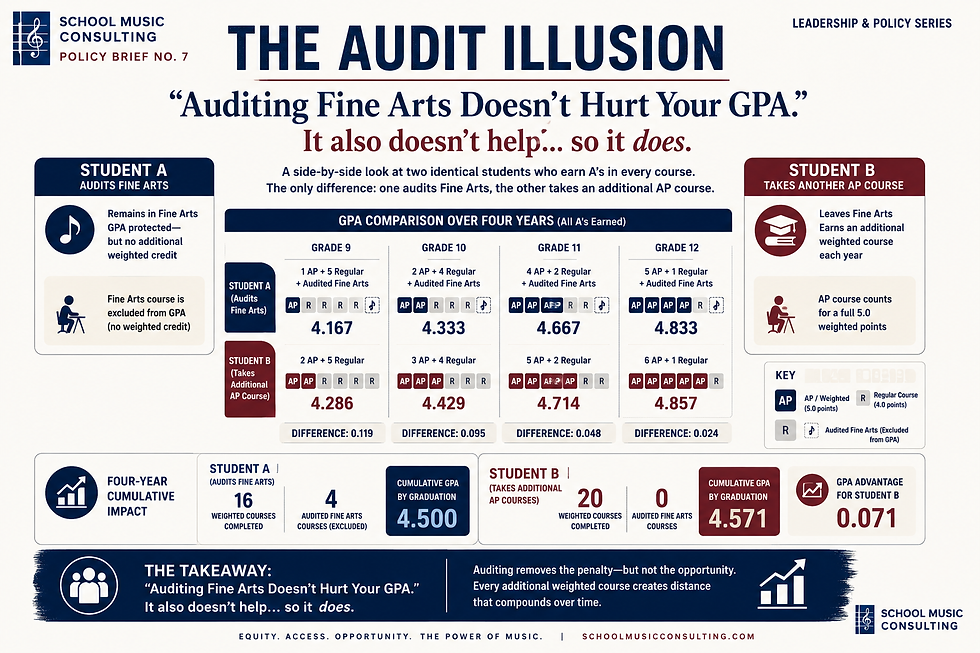
Source: Illustrative model developed by School Music Consulting. Based on a hypothetical 5.0 weighted GPA system; not intended to represent any specific district's calculations.
International Recognition, Local Policy

The conversation becomes even more interesting when viewed through an international lens.
The International Baccalaureate Diploma Programme, recognized by universities around the world, organizes its curriculum into six academic subject groups: Studies in Language and Literature, Language Acquisition, Individuals and Societies, Sciences, Mathematics, and The Arts.
That distinction matters.
In one of the world's most respected pre-university academic frameworks, the arts are not treated as extracurricular enrichment. They are recognized as a legitimate field of academic study alongside mathematics, science, history, and languages.
Yet many American weighted GPA systems tell a different story.
Advanced Placement, International Baccalaureate coursework, Dual Credit, and honors academic classes routinely receive additional weight in GPA calculations. Advanced artistic study often does not.
This isn't because the arts lack academic rigor.
It is because local policy has chosen to recognize some forms of advanced study differently than others.
Arlington ISD's Honors Fine Arts program demonstrated that another approach is possible.
Arlington's Response
While serving as Director of Fine Arts in Arlington ISD, we began hearing the same concerns from students, parents, teachers, counselors, and principals.
The issue wasn't instructional quality.
The issue wasn't student commitment.
The issue was policy alignment.
Working alongside Fine Arts Coordinator Rob Myers and our colleagues in Academic Services, we studied districts that had already addressed the problem. Plano ISD provided one successful model. Rather than reinventing the wheel, we adapted proven ideas to Arlington's needs.
The result was the creation of Honors Fine Arts coursework.
Importantly, this wasn't weighted credit simply for participating in Band, Choir, Orchestra, Theatre, Dance, or Visual Art.
Students pursuing Honors Fine Arts completed advanced work within their discipline that included teacher approval, independent research, significant work beyond the regular school day, and demonstrated achievement over multiple years. Students could earn one Honors Fine Arts credit each year beginning in their second year of study.
The objective was never to make Fine Arts identical to AP or IB coursework. The objective was much simpler. To recognize that advanced artistic study is, in fact, advanced study. After months of collaboration and refinement, Arlington ISD adopted the program.
More importantly, students no longer had to choose between continuing their artistic development and protecting their academic standing.
One District's Example
Every district has different graduation requirements.
Different accountability systems.
Different local priorities.
Arlington's approach is not the only possible solution. It is, however, a practical one.
Nearly a decade later, Arlington ISD continues to publish its Honors Fine Arts requirements in its High School Course Description Guide. Students in their second year or beyond of a Fine Arts discipline may enroll with teacher approval while completing honors-level expectations that include independent research and work beyond the regular school day.
As I updated this article, I searched for comparable examples around the country. While many districts weight Advanced Placement, International Baccalaureate, Dual Credit, or honors academic coursework, relatively few appear to have established formal honors pathways for advanced Fine Arts study. Arlington's model remains one example educational leaders may wish to examine.
For school systems beginning this conversation, there is no need to start with a blank sheet of paper.
One model already exists.
Current Arlington ISD Honors Fine Arts Course Description
Honors Fine Arts Courses are designed for students interested in more rigor in a chosen Fine Arts discipline. These courses are available to 10th-12th students in the second year or higher of that discipline. Enrollment requires approval from the fine arts teacher of record for the chosen discipline. Extensive research and outside-of-school day work are required. One Honors Fine Arts credit is allowed per year — Arlington ISD, 2026.
Study it.
Adapt it.
Improve upon it.
That is how educational leadership moves forward.
New Jersey Chose a Different Path
Texas is not the only state to wrestle with this issue.
In 2016, New Jersey became the first state to enact a law requiring school districts to weight visual and performing arts courses equally with other courses of the same level of academic rigor when calculating grade point averages. Rather than giving the arts preferential treatment, the law recognized a simple principle: courses of equal academic rigor should receive equal consideration.
The legislation demonstrates that this conversation is not merely theoretical. States can preserve academic rigor while ensuring that GPA policies do not unintentionally discourage participation in music, theatre, dance, and visual art.
While Arlington ISD found a local solution, New Jersey demonstrates that the same principle can also be addressed through statewide policy.

This Was Never Only About GPA
At first glance, weighted GPA feels like a technical policy discussion.
It isn't.
It is a leadership discussion.
Over the past several months, I've written about the financial impact of comprehensive music programs, the relationship between sustained arts participation and student attendance, the unintended consequences of master scheduling, and the remarkable ability of comprehensive public schools to develop students who excel across multiple disciplines.
Each of those articles points toward the same conclusion.
Educational systems produce what they are designed to produce.
If schools genuinely believe creativity, collaboration, perseverance, communication, leadership, and disciplined practice matter, then the systems we design should reinforce those beliefs—not unintentionally discourage them.
Policies don't merely organize schools.
They shape culture.
Help Continue the Conversation
This policy has now been part of Arlington ISD for nearly a decade. That alone suggests it addressed a genuine need.
I'd like this article to become more than a retrospective.
I'd like it to become a resource.
An Invitation to Former Arlington ISD Students and Educators
Were you a student, teacher, counselor, administrator, or parent who experienced Arlington ISD's Honors Fine Arts program?
I'd love to hear your perspective.
How, if at all, did this policy influence your educational experience or the decisions students made? Your reflections may help future educational leaders better understand how policy shapes student opportunity.
An Invitation to School Districts Across the Country
Does your school district recognize advanced Fine Arts coursework through weighted GPA, honors credit, advanced arts scholars programs, or another innovative approach?
If so, I'd love to learn about it.
One of the goals of School Music Consulting is to identify effective ideas from across the country and share them with educational leaders. If your district has developed a successful model, please send me your policy, course guide, or a brief description.
I'll continue updating this article as additional examples and perspectives emerge.
Educational leadership is rarely about finding perfect solutions.
More often, it is about identifying unintended consequences and having the courage to improve the systems we have inherited.
Every school district is different.
Every community has different priorities.
Every state has different accountability systems.
But every educational leader should occasionally stop and ask one simple question:
Do our policies encourage the educational experiences we say we value?
Because every policy sends a message.
And students (and parents) are always listening.
∗ ∗ ∗
Related Leadership Briefs
If this article is helpful, you may also enjoy:
📈 The Unexpected Attendance Strategy: What Virginia's research suggests about arts participation and chronic absenteeism.
🎓 IB Means, In Band: How master scheduling can eliminate the false choice between academic rigor and music.
🏫 The Accidental Masterpiece: Why North Texas built some of America's most comprehensive public schools.
∗ ∗ ∗
Jeremy L. Earnhart, Ed.D.
Founder & Principal
School Music & Fine Arts, LLC
Former President & CEO, Music for All
Former Director of Fine Arts, Arlington ISD & Irving ISD
Research at the intersection of educational strategy, organizational design, and school finance. Helping school leaders uncover hidden capacity, strengthen student opportunity, and improve organizational performance through strategic fine arts design.
His work has been covered by The New York Times, NPR/KERA, Marketplace, CBS 11, NBC 5, and the Fort Worth Star-Telegram. The New York Times highlighted Arlington ISD's decision to eliminate instrument rental fees, noting that band participation at the middle and high school levels "jumped" (Rich, 2015).
That work continues in The Cost of Not Playing (2026), Dr. Earnhart’s ongoing research on the systems-level impact of music participation in public schools.

His doctoral research centered around the competencies of the central office music administrator:



Comments