
Uniquely American: School Music

What an Unexpected Conversation in Anaheim Reminded Me About One of America's Greatest Institutions

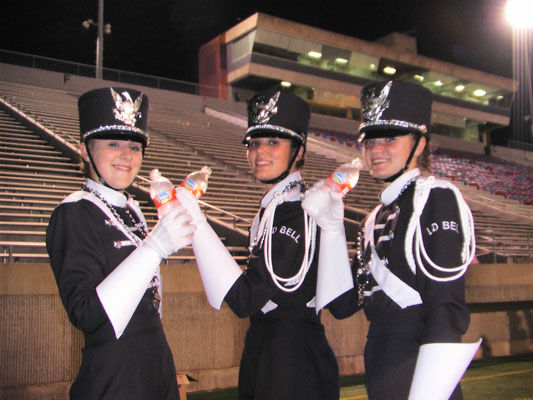
Over Christmas Break, I traveled to Anaheim to watch our daughter, Kierstyn, lead the Brownsburg High School Band as drum major in Disneyland's Downtown Disney parade — part of the band's Rose Parade trip, just ahead on New Year's Day.
Running a little behind that morning, I grabbed an Uber from the hotel instead of walking. After spending the day with the band, I requested another ride to John Wayne Airport.
The same driver picked me up.
On the drive to the airport, he asked what had brought me to Anaheim.
"I've spent my career in music education," I said. "I came to watch my daughter perform."
His face lit up. "My son was in band."
His son had attended Savannah High School in California. Years earlier, his son had asked him, "Dad, why don't you ever come to one of our performances?" So one day, he did.
Before the performance, he asked, "How many people are in your band?"
"About 350."
He smiled. "No — not in your school. In your band."
"About 350," his son said again.
Only then did it register. He simply couldn't conceive of a school band with 350 students.
Then the performance began. He watched hundreds of students — brass, woodwinds, percussion, keyboards, flags — moving together with remarkable precision. Then the performance began. He watched hundreds of students breathe together, move together, hold together. No one out of place. No one left behind.
But what struck him most wasn't the music itself. It was the relationship between the students and their director. Three hundred fifty teenagers watching every gesture, trusting one teacher completely, hanging on every instruction.
Growing up in India, he loved music. This wasn't about discovering music. It was about discovering something uniquely American.
That conversation stays with me still.
America did not invent music. America did not invent the trumpet, the violin, the choir, or the orchestra.
America's unique contribution wasn't creating music — it was democratizing participation in music.
Over nearly two centuries, America built something unlike almost anywhere else in the world: a public school music system where millions of young people learn, perform, and belong through large ensembles.
The roots of that story reach back to America's early singing schools and the shaped-note tradition, where folks learned to read music so their congregations could worship with greater confidence and unity. Music was never separate from faith — it was in service to it.
That same conviction—that music could unite people in shared purpose and worship—became the catalyst for what followed. Lowell Mason, often called the father of American music education, carried that spirit into the public schools, believing music literacy belonged not to the privileged few, but to every child.
Over generations, that vision expanded into elementary general music, beginning band, orchestra, choir, jazz ensembles, concert bands, and marching bands — not because every student would become a professional musician, but because every student deserved to be part of something larger than themselves.
My driver never talked about how difficult the music was. He never mentioned competitions or trophies. He wasn't impressed by the instruments.
He was captivated by the ensemble — and by what stood behind it. Three hundred fifty young people learning to listen, lead, follow, trust, sacrifice, and achieve together. And behind them, one teacher who had earned their trust and turned hundreds of individuals into a single community.
That influence doesn't end when the final note is played. Those 350 students will become parents, teachers, engineers, nurses, entrepreneurs, first responders, military leaders, and public servants — each one touching hundreds, perhaps thousands, of others over a lifetime. The ripple effect of one great music educator extends far beyond the rehearsal hall.
Think about it. Here are hundreds of teenagers who can't agree on where to eat lunch, yet they willingly put on the same uniform, play the same music, execute the same choreography, and pursue the same goal—all in service of one another, their school, and something larger than themselves.
Perhaps that's why those of us who have spent our lives in music education sometimes forget how extraordinary this institution really is. We see it every day. Sometimes it takes someone seeing it for the first time to remind us.
As we celebrate Independence Day, I'm grateful for one of America's greatest institutions—not simply because it teaches music, but because it reminds us that a free society depends on people learning to do extraordinary things together.
Perhaps that is America's greatest composition.
Happy Fourth of July.
The Earnharts


Comments