
The Sixth Grade Pipeline

Updated: Sep 2

Leadership Brief No. 1
The Sixth Grade Pipeline
How the Point of Entry Determines the Strength of the Entire System
Companion Article:
The Sixth Grade Decision:
Why the Most Important Scheduling Decision a School District Makes Happens Before Middle School Begins
Jeremy L. Earnhart, Ed.D.
District Fine Arts Leader • Education Strategist
Editor's Note:
Previous articles in this series examined the economics of music participation. This article covers the front door to the system: the scheduling decision that determines who ever has the opportunity to participate.
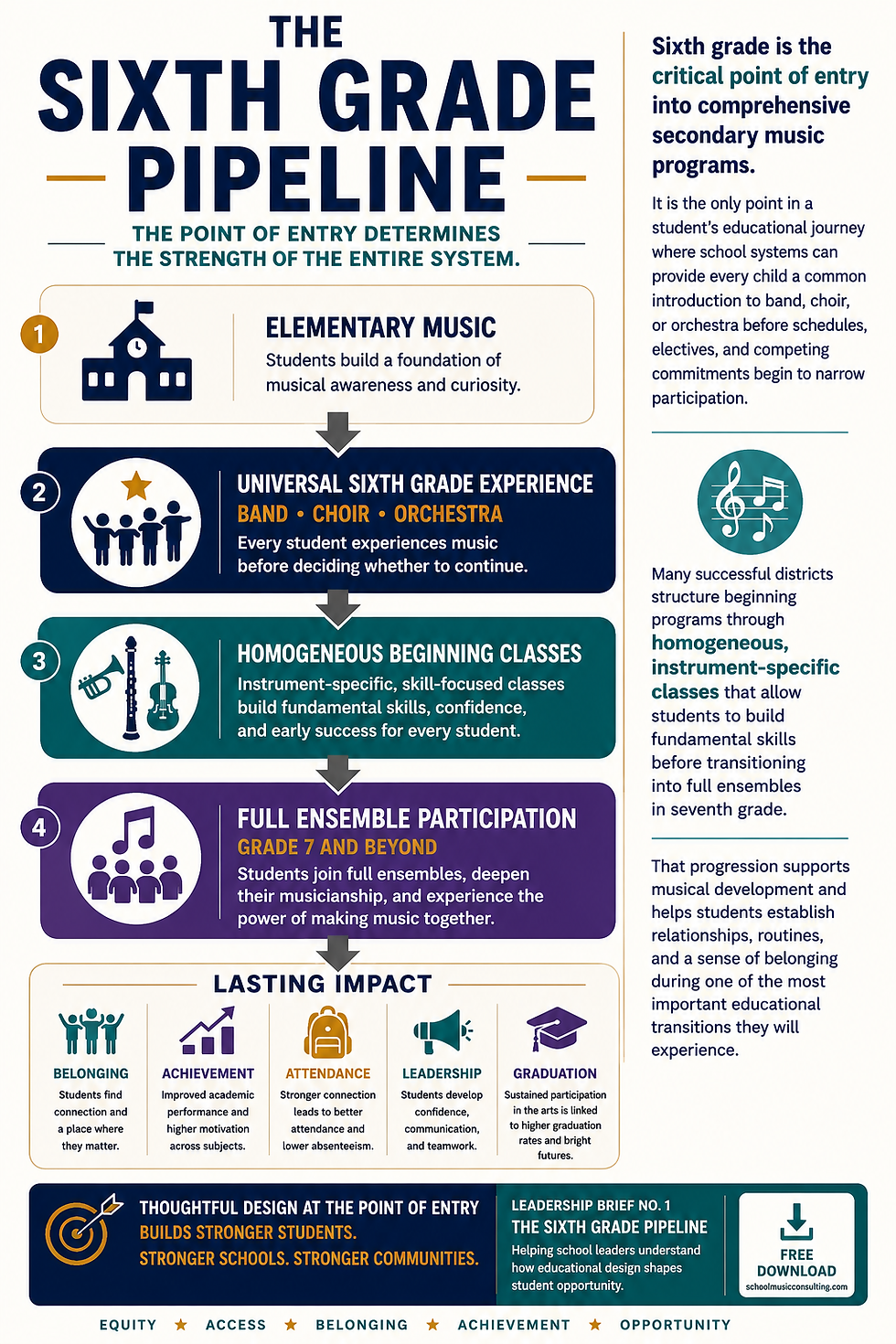
This article is accompanied by Leadership Brief No. 1: The Sixth Grade Pipeline—a one-page visual designed for principals, district leaders, and school boards. Although titled The Sixth Grade Pipeline, its principles apply to the first year of instrumental and choral instruction in any school district, regardless of grade configuration.
***
Leadership Insight
"Choice without exposure is not really choice."
Every school district eventually asks the same question: how do we increase participation in band, choir, and orchestra?
Districts organize recruiting nights. They produce promotional videos. They visit elementary schools, host instrument fitting events, and launch retention campaigns. Those efforts matter.
But they all begin after the most important decision has already been made.
The most consequential decision a district makes about secondary music participation does not happen in high school.
It happens in sixth grade.
Or, more precisely, it happens the moment a district decides whether every child will experience music before being asked whether they want it.
But why?
In practice, that exposure typically begins through homogeneous beginning classes organized by instrument or, while less effective, as an ensemble. Sixth grade serves as the critical point of entry into comprehensive secondary music programs, providing every student a common introduction to band, choir, or orchestra before schedules, elective pathways, and competing commitments begin to narrow participation. Students build foundational musical skills, confidence, and a sense of belonging before transitioning into full ensembles in seventh grade. This progression not only supports musical development, but also helps students establish relationships, routines, and community during one of the most important educational transitions they will experience.
Districts adopting this model continue providing intervention, advanced academics, CTE pathways, and other student supports. The decision is not whether schools value literacy, mathematics, or intervention. The decision is whether every child should also experience one year of comprehensive music before choosing a long-term pathway.
Rather than competing with academic priorities, well-designed beginning music programs complement them by strengthening belonging, developing durable human capabilities, and encouraging sustained participation.

The Access Gap
One of the greatest barriers to music participation has never been talent. It has always been access.
Students whose parents participated in band, choir, or orchestra often arrive at middle school already expecting to join. Music is simply part of what their family does. Many other students have never experienced that world. That difference is not a talent gap. It is an opportunity gap.
When a population is not predisposed to participation—particularly in communities experiencing poverty—the responsibility shifts from the family to the school system. Parents who never had the opportunity to participate in school music themselves are often less likely to encourage, or even recognize the value of encouraging, their children to participate.
Waiting for students to discover music on their own does not create equal opportunity. It preserves unequal access.
If we believe music is part of a complete education — not simply an enrichment opportunity — then it is incumbent upon the school system to provide meaningful exposure at the point of entry and allow students to elect continued participation thereafter.
That is exactly what many districts do. Students are not required to remain in music. They are simply guaranteed the opportunity to experience it before being asked to choose.
Because choice without exposure is not really choice.
The Unexpected Attendance Strategy
Leadership Insight
"Belonging is an attendance strategy."
While serving as Director of Fine Arts in Irving ISD, a high-poverty mid-urban school district, I was appointed to the District Improvement Plan committee for Attendance and Dropout Prevention. Like many committee assignments, it initially seemed unrelated to my department. It completely changed the way I think about music education.
As we examined district attendance patterns, one observation kept resurfacing: schools with stronger fine arts participation consistently demonstrated stronger attendance.
Long before chronic absenteeism became one of the defining conversations in American education, we recognized a simple truth — students are more likely to attend places where they feel connected. Music programs create belonging, not accidentally, but by design. Every rehearsal matters. Every student contributes. Every absence affects someone else. That experience is fundamentally different from simply occupying another seat in another classroom.
Today, districts across the country are investing enormous amounts of time, energy, and funding trying to reduce chronic absenteeism. Long before chronic absenteeism became a national accountability priority, music educators were building the conditions that reduce it: belonging, responsibility, purpose, and shared commitment. That matters educationally. It also matters financially. In many states, school districts receive funding based, at least in part, on Average Daily Attendance (ADA). Programs that strengthen belonging do more than improve school climate. They also help protect the funding that makes learning possible.
The educational case and the financial case point in exactly the same direction. Belonging is not simply a student outcome. It is an attendance strategy.
Our committee ultimately recommended requiring every sixth-grade student to enroll in beginning band, choir, or orchestra for one year. Several of our campuses were already doing so successfully — as well as neigboring districts — and the recommendation became part of Irving ISD's District Improvement Plan. Students were never required to continue beyond that first year. They were simply guaranteed meaningful exposure before making an informed choice.
Between 2009 and 2014, secondary fine arts participation increased approximately 40 percent across Irving ISD, while individual programs experienced dramatic enrollment growth.
The lesson has stayed with me ever since: always take the committee assignment.
Sometimes the most important ideas emerge outside your own department.
Many Successful Districts Have Reached the Same Conclusion
Universal beginning music is sometimes portrayed as unusual. It isn't. Many highly successful school districts have independently reached the same conclusion.
In North Texas, examples include Allen ISD, Carrollton-Farmers Branch ISD, Northwest ISD, and Wylie ISD, among others. In Indiana, examples include Avon Community Schools, Brownsburg Community Schools, Carmel Clay Schools, and the Plainfield Community School Corporation.
These districts differ dramatically in size, demographics, geography, and governance. What they share is an understanding that sixth grade represents the only practical point of universal entry into the system-wide benefits of sustained secondary music participation.
Whether recognized explicitly or simply embedded in district practice, they are solving the same organizational challenge: providing equitable access while building stable, efficient secondary programming.
Participation Density Matters
One of the unintended consequences of expanding elective choice is that it can reduce participation in every program. A fixed population of students can only be distributed so many ways.
As districts create additional entry points, parallel pathways, or an increasing number of beginning-level elective options, participation density declines. Enrollment fragments across more programs, making each one more difficult to sustain.
Expanding choice has organizational consequences. Program continuity weakens. Long-term retention declines. Eventually, the efficiency of the master schedule begins to erode.
Ironically, in attempting to create more choices, school systems can unintentionally reduce the number of students who experience sustained participation in anything. Every additional point of entry carries organizational consequences that ripple through participation, staffing, scheduling, and long-term program stability.
This is not an argument against choice.
It is an argument for sequencing.
Students deserve broad opportunities.
The question is when those opportunities should be introduced.
Many successful districts have independently reached the same conclusion: provide a common beginning experience first, then expand elective choice after students have developed foundational skills, meaningful relationships, and a sense of belonging.
Participation density is not the opposite of choice.
It is what makes meaningful choice sustainable.
These districts intentionally design secondary music as a vertically aligned Grade 6–12 learning community—a school within a school—that supports students from their first day of beginning music through graduation.
Whether intentionally designed or simply refined over time, these districts have also adopted one of the most staffing-efficient instructional models available in secondary education.
Large Ensemble Music Is Infrastructure
Leadership Insight
"Participation is a staffing strategy. Enrollment design is staffing policy."
Most conversations about beginning music focus exclusively on student outcomes. There is another dimension that deserves equal attention. It has little to do with music and everything to do with how school systems function.
Large ensemble music is instructional infrastructure.
Like transportation, technology, or facilities, it is a system that enables other educational outcomes to occur efficiently and consistently. A highway efficiently moves large numbers of vehicles, large ensemble music efficiently moves large numbers of students through the master schedule. Band, choir, and orchestra allow hundreds of students to participate in collaborative, standards-based instruction while being served by relatively few teachers.
When participation is high, master schedules become more stable, staffing pressure decreases, elective fragmentation declines, and students experience sustained community.
When participation declines, students do not disappear. They disperse — across additional electives, additional class sections, additional staffing, additional complexity throughout the master schedule.
Applying this structural model to districts such as Denton ISD illustrates the scale of the opportunity. Analytical modeling suggests that relatively modest increases in secondary music participation could reduce long-term staffing pressure by approximately twenty teaching positions across four comprehensive high schools — 20 FTE, roughly $1.5 million annually.
This is not a description of Denton ISD policy or practice. It is an illustration of how enrollment design influences staffing demand.
Participation is a staffing strategy.
Enrollment design is staffing policy.
Viewed this way, sixth-grade music is not simply a fine arts decision.
It is an educational design decision.

The Skills That Endure
The case for requiring beginning music extends well beyond music itself. Research has long connected sustained arts participation with improved academic performance, stronger family engagement, higher graduation rates, and improved social-emotional development.
Programs that move hundreds of students through collaborative, feedback-rich learning environments are not simply producing musicians. They are producing adaptable human beings.
Music also develops many of the enduring human capabilities employers increasingly seek: collaboration, communication, persistence, adaptability, leadership, rgrit, and resilience. In an era increasingly shaped by artificial intelligence, those capabilities become even more valuable.
The goal is not to produce musicians. The goal is to produce capable human beings.
The Better Question
For years, districts have debated whether beginning music should be required. I believe they are asking the wrong question.
The real question is much simpler. Whether every child deserves meaningful exposure before being asked to decide. Because choice without exposure isn't really choice.
When districts intentionally create that exposure, something remarkable happens. Students discover they belong. Attendance improves. Master schedules stabilize. Staffing becomes more efficient. Communities become stronger. That may be why so many of our high-performing music districts begin in exactly the same place: ensuring every child has the opportunity to experience music before deciding whether to continue.
The goal was never simply to create more musicians.
The goal was always to create more opportunity.
Sixth grade just happens to be where that opportunity begins.
***
Jeremy L. Earnhart, Ed.D.
Founder & Principal
School Music & Fine Arts, LLC
Former President & CEO, Music for All
Former Director of Fine Arts, Arlington ISD & Irving ISD
Research at the intersection of educational strategy, organizational design, and school finance. Helping school leaders uncover hidden capacity, strengthen student opportunity, and improve organizational performance through strategic fine arts design.
His work has been covered by The New York Times, NPR/KERA, Marketplace, CBS 11, NBC 5, and the Fort Worth Star-Telegram. The New York Times highlighted Arlington ISD's decision to eliminate instrument rental fees, noting that band participation at the middle and high school levels "jumped" (Rich, 2015).
That work continues in The Cost of Not Playing (2026), Dr. Earnhart’s ongoing research on the systems-level impact of music participation in public schools.

His doctoral research centered around the competencies of the central office music administrator:
Earnhart, J. L. (2017). Competencies of the public school music administrator: Texas music administrator perspectives. Journal for K-12 Educational Leadership, 1(1), 55–63.



Comments