
The Cost of Not Building Swiss Army Knife Graduates

Updated: Aug 9
Part III of III — Casio PT-1, AI, and All of Us
Missed Part I or II?
Read Part I —
Read Part II —

At the end of Part II, we asked two questions.
Which programs, already sitting inside your district, have been quietly building Swiss Army Knife Graduates all along?
And what are they worth?

In September 2024, I stood at a podium in front of the Indiana State Board of Education.
The board was considering a proposal to remove Fine Arts as a graduation requirement. If it passed, Indiana would join Nevada as the only state in thirty years to make that move.
I wasn't there as a consultant. I was there as a parent.
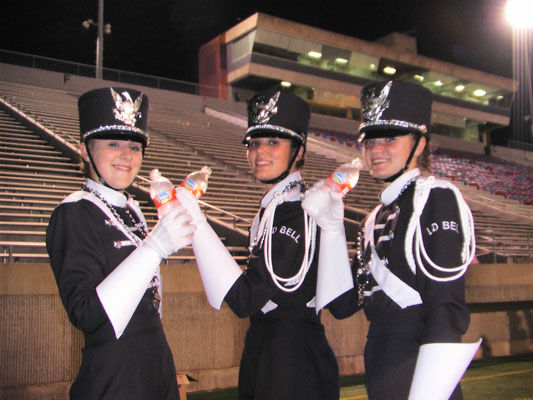
My daughter was fulfilling her Fine Arts and Physical Education requirements as a trumpet player in her high school marching band. My wife had done the same a generation earlier as a drum major — and was now working as a grant accountant for a public school system. I told the board there is simply no time for the things that derail a teenager's life during a twelve-hour marching band rehearsal day.
Then I made the economic case. In the two months following that hearing, more than two hundred high school marching bands would perform at Lucas Oil Stadium, generating over thirty million dollars in economic impact for the city of Indianapolis — produced largely by students fulfilling a graduation requirement the board was about to eliminate.
I told them: rather than specializing kids into specific business tools, we must empower them to become economic-generating Swiss Army knives. Not to build professional artists. To build professional people.
That argument had nothing to do with artificial intelligence. AI wasn't part of the conversation in that room.
But AI has since raised the stakes on every word of it.
Most budget conversations about music education start from the wrong question.
They ask: can we afford this program?
The better question is: what does it cost when students don't participate in it?
Because when a district narrows access to music, it doesn't make the students disappear. It just moves them somewhere else in the building. A student who isn't in band, choir, or orchestra still needs a class period. That period still needs a teacher, a room, a slot in the master schedule, and a line in the budget. The cost doesn't go away. It relocates — usually into a less efficient corner of the school.

That's the hidden mistake in nearly every conversation about cutting fine arts.
Large-group music programs routinely serve hundreds of students under reletively few teachers. They satisfy graduation requirements. In many states, they can simultaneously fulfill Fine Arts credit and Physical Education credit. They create school identity, community pride, and—as Indianapolis demonstrates every fall—tens of millions of dollars in direct economic activity generated by students fulfilling a graduation requirement.
That isn't extracurricular.
That's infrastructure.
The old argument said music education mattered because it produced test scores.
The better argument is that music education produces professionals.
Not necessarily professional artists.
Professional people.
***
This isn't a new idea. In 2009, author and business thinker Daniel Pink addressed the Texas Music Educators Association and told them that what the next economy needs isn't professionals who function as vending machines dispensing right answers. It needs professionals who ask the right questions—with, in his words, "the observation skills of a sculptor or a painter" (Pink, 2009).
He wasn't describing a music student. He was describing a physician.
Harvard reached the same conclusion—and continues to act on it.

"Music and healing have been inextricably linked throughout history" (Wong, 2014).
Dr. Lisa Wong's work at Harvard Medical School reminds us that technical expertise alone is only part of professional excellence. Great physicians—and great professionals—must also learn to observe, listen, and ask better questions.
A landmark systematic review published in Academic Medicine found that empathy commonly declines during medical education, particularly during the clinical years (Neumann et al., 2011). That finding matters because empathy isn't simply a desirable personality trait. Higher physician empathy has been associated with improved patient outcomes, including better control of chronic conditions such as diabetes (Hojat et al., 2011).
Rather than accepting that decline as inevitable, leading medical schools began exploring how music, literature, storytelling, and the visual arts could help cultivate the observation, listening, communication, empathy, and human judgment that great physicians require.
Harvard Medical School's Arts and Humanities Initiative is one example of that broader movement. Co-directed by pediatrician and violinist Dr. Lisa Wong, the initiative integrates music, storytelling, literature, and the visual arts into physician education to strengthen observation, empathy, and human judgment.

The observation skills of a sculptor or a painter.
The listening skills of a musician.
In a doctor.
That is the Swiss Army Knife argument made at one of the nation's leading medical schools. And it was made before artificial intelligence entered the conversation.
AI has only made it more urgent.
***
Those professionals aren't defined by talent alone. They're defined by what they learn to do with talent over time.
In her book Grit, psychologist Angela Duckworth offers a framework worth sitting with: talent multiplied by effort produces skill, and skill multiplied by effort produces achievement. Effort appears in both equations. Talent appears in only one.
A first-chair player is rarely the most naturally gifted student in the room. More often, she's the one who practiced consistently, absorbed criticism without quitting, and kept showing up long after the novelty of talent wore off. The ovation lasts a few seconds. The work behind it took years nobody in the audience witnessed.

Stephen Covey described a version of this decades earlier— The Law of the School versus the Law of the Farm. The law of the school rewards a single performance on a single day. The law of the farm requires patience. You cannot cram a harvest.
Artificial intelligence can generate an answer in seconds.
It cannot teach grit.
That gap — between instant output and earned capability — is exactly where the Swiss Army Knife Graduate is built. And it's exactly where most music programs have quietly been operating for a hundred years.
Here's what gets lost when a district treats music as a line item instead of a system.
A band student isn't just learning notes and rhythms. She's learning precision, timing, and what it feels like when her preparation — or lack of it — affects everyone around her.
A choir student isn't just learning repertoire. He's learning to blend his voice into something larger than himself, to be heard and corrected in front of his peers, and to come back the next day anyway.
An orchestra student isn't just learning technique. She's learning the slow, unglamorous arithmetic of getting better — a little, every day, for years, with no shortcut available. None of that shows up neatly on a standardized test. It shows up twenty years later—in a paycheck, a leadership role, a team meeting, a difficult conversation, a promotion, and a life well lived.
These are not soft skills.
They're durable skills.
And in an economy where machines can generate a polished answer in seconds, durable skills may be the only ones that hold their value.
The irony is that most districts already own this infrastructure. They have the teachers. The rehearsal rooms. The instruments. The institutional memory and the community support.
They have, in many cases, decades of evidence that the model works.
What they don't always recognize is that the system they're trying to design from scratch is already in place. It doesn't need to be reinvented. It needs to be scaled. It may represent one of the largest untapped returns on investment in public education—hidden in plain sight. (↓)

If a superintendent assembled a task force tomorrow to build a program from nothing — one that's collaborative, project-based, performance-driven, feedback-rich, and capable of carrying students through failure toward mastery — they would likely end up reinventing the school band room.
The tragedy of the last thirty years isn't that music education failed to prove its value.
It's that too many districts never asked the question in a way that let the answer register.
A district can say it values creativity, adaptability, and workforce readiness.
But the master schedule tells the truth.
The budget tells the truth.
Staffing formulas tell the truth.
If a district says it wants graduates who can integrate, lead, and keep learning as the tools change—and then keeps shrinking the one program already built to produce exactly those qualities—it is actively failing to prepare students for the next fifty years.
It's preparing them for an accountability system designed for a world that no longer exists.

The Casio PT-1 never made anyone a musician.
Artificial intelligence will not make anyone educated.
Both can produce sound. Both can generate output. Both can create the appearance of accomplishment in an instant.
Real learning still requires curiosity, repetition, feedback, and time. Human development obeys the laws of cultivation—not optimization. You cannot spreadsheet your way into a harvest.
The future will not belong to the graduate who simply knows how to use today's tools.
It will belong to the graduate who can learn tomorrow's tools, connect them to enduring human problems, and create value no curriculum guide could have predicted.
The Swiss Army Knife Graduate is not a music student. It is the graduate every district says it wants. Music simply happens to be one of the most proven places we already know how to build one.
That is why music education matters.
Schools have spent decades asking whether music belongs in education. Artificial intelligence may finally force us to ask the opposite question:
What if education has more to learn from music?
Not as nostalgia. Not as enrichment. Not as a line item to defend every budget season.
As infrastructure.
As workforce development.
As one of the most efficient systems a school district already owns for building the kind of human capability artificial intelligence cannot replace.
So the question every school district will eventually have to answer is no longer whether it can afford music education.
The question is whether it can afford the cost of not building Swiss Army Knife Graduates.
Whether it can afford the cost of not playing.
References
Derksen, F., Bensing, J., & Lagro-Janssen, A. (2013). Effectiveness of empathy in general practice: A systematic review. British Journal of General Practice, 63(606), e76–e84. https://pmc.ncbi.nlm.nih.gov/articles/PMC3529296/
Hojat, M., Louis, D. Z., Markham, F. W., Wender, R., Rabinowitz, C., & Gonnella, J. S. (2011). Physicians' empathy and clinical outcomes for diabetic patients. Academic Medicine, 86(3), 359–364. https://academic.oup.com/academicmedicine/article-abstract/86/3/359/8352869
Neumann, M., Edelhäuser, F., Tauschel, D., Fischer, M. R., Wirtz, M., Woopen, C., Haramati, A., & Scheffer, C. (2011). Empathy decline and its reasons: A systematic review of studies with medical students and residents. Academic Medicine, 86(8), 996–1009. https://doi.org/10.1097/ACM.0b013e318221e615
Pink, D. H. (2009). A Hard-Headed Case for Arts Education [Keynote address]. Texas Music Educators Association Clinic/Convention.
Wong, L. M. (2014). Music and Medicine: Harnessing Discipline and Creativity. AMA Journal of Ethics, 16(8), 648–651. https://doi.org/10.1001/virtualmentor.2014.16.08.mhst1-1408
∗ ∗ ∗
Jeremy L. Earnhart, Ed.D.
Founder & Principal
School Music & Fine Arts, LLC
Former President & CEO, Music for All
Former Director of Fine Arts, Arlington ISD & Irving ISD
Research at the intersection of educational strategy, organizational design, and school finance. Helping school leaders uncover hidden capacity, strengthen student opportunity, and improve organizational performance through strategic fine arts design.
His work has been covered by The New York Times, NPR/KERA, Marketplace, CBS 11, NBC 5, and the Fort Worth Star-Telegram. The New York Times highlighted Arlington ISD's decision to eliminate instrument rental fees, noting that band participation at the middle and high school levels "jumped" (Rich, 2015).
That work continues in The Cost of Not Playing (2026), Dr. Earnhart’s ongoing research on the systems-level impact of music participation in public schools.

His doctoral research centered around the competencies of the central office music administrator:
Earnhart, J. L. (2017). Competencies of the public school music administrator: Texas music administrator perspectives. Journal for K-12 Educational Leadership, 1(1), 55–63.


Comments